Tuesday, January 17, 2017

A mind at ease = better sleep.


Venture Funding Deals: Stem Cell Venture BlueRock Launches With Major Funding


A mind at ease = better sleep.

HeadspaceVerified account

@Headspace

Headspace is meditation made simple. Learn with our app or online, when you want, wherever you are, in just 10 minutes a day.
Los Angeles | London
Joined October 2011

10 mindful attitudes that decrease anxiety


Mindful Practice


Jan 15
How mindfulness helps us reach beyond our own newsfeed and address what lies beneath others' hate and pain

For your : how to work with grief, sadness and seasonal depression by


Take a journey through bias with awareness and kindness with Vinny Ferraro of
One of the benefits of this off-the-cushion practice: It doesn’t separate meditation from day-to-day living.

Taking time to show empathy and really listen to others is great for our relationships - and helps reduce stress too

A compelling/surprising practical application of mindfulness training from


Meditation is not all calm and peace. It opens up a space for you to see what’s going on in your mind.


With a solid meditation practice, we can better cope with everyday stressors.


10 mindful attitudes that decrease anxiety


Wednesday, January 11, 2017

Mindfulness - history channel documentary - Psychology of Mindfulness - ...


Published on Dec 16, 2015
Mindfulness - history channel documentary - Psychology of Mindfulness - What We Know and Don't Know
https://youtu.be/kbeCdkdPTHg

I created this video with the YouTube Video Editor (http://www.youtube.com/editor)
Creative Commons Attribution license (reuse allowed)
https://creativecommons.org/licenses/...
https://support.google.com/youtube/an...
Origin: https://www.youtube.com/watch?v=Dsq7N...
Author: http://www.youtube.com/channel/UClF4j...

Marc S. Schulz, PhD

Rachel C. Hale Professor in Science and Mathematics

Bryn Mawr College

7 pm, Monday, November 16, 2015

Commonwealth Chateau on the SugarLoaf Campus of Chestnut Hill College

Meditation
and other mindfulness practices are hot commodities in contemporary
American popular culture. Ever widening circles of people are becoming
interested in the benefits that mindfulness can offer in stress-relief,
well-being and physical health. This talk will highlight modern
conceptualizations and implementation of mindfulness practices that have
arisen in the West and review scientific research that examines the
potential health benefits of these practices.

http://irands.org/event/science-of-mi...

Mindfulness - history channel documentary - Psychology of Mindfulness - What We Know and Don't Know

Tuesday, January 10, 2017

Atul Gawande: How do we heal medicine?


Published on Apr 16, 2012
http://www.ted.com
Our medical systems are broken. Doctors are capable of extraordinary
(and expensive) treatments, but they are losing their core focus:
actually treating people. Doctor and writer Atul Gawande suggests we
take a step back and look at new ways to do medicine -- with fewer
cowboys and more pit crews.


Sunday, January 8, 2017

Leonard Cohen Performs Anthem


Anthem Lyrics by Leonard Cohen


Anthem
Leonard Cohen
The birds they sang
At the break of day
Start again
I heard them say
Don't dwell on what
Has passed away
Or what is yet to be
Yeah the wars they will
Be fought again
The holy dove
She will be caught again
Bought and sold
And bought again
The dove is never free
Ring the bells (ring the bells) that still can ring
Forget your perfect offering
There is a crack in everything (there is a crack in everything)
That's how the light gets in
We asked for signs
The signs were sent
The birth betrayed
The marriage spent
Yeah the widowhood
Of every government
Signs for all to see
I can't run no more
With that lawless crowd
While the killers in high places
Say their prayers out loud
But they've summoned, they've summoned up
A thundercloud
And they're going to hear from me
Ring the bells that still can ring
Forget your perfect offering
There is a crack, a crack in everything (there is a crack in everything)
That's how the light gets in
You can add up the parts
You won't have the sum
You can strike up the march
There is no drum
Every heart, every heart to love will come
But like a refugee
Ring the bells that still can ring
Forget your perfect offering
There is a crack, a crack in everything (there is a crack in everything)
That's how the light gets in
Ring the bells that still can ring (ring the bells that still can ring)
Forget your perfect offering
There is a crack, a crack in everything (there is a crack in everything)
That's how the light gets in


Songwriters: Leonard Cohen
Anthem lyrics © Sony/ATV Music Publishing LLC


Healing from Within: Jon Kabat-Zinn (Public Broadcasting System)


Published on Feb 21, 2016
Healing
From Within was first broadcast in 1993 and features Jon's MBSR
(Mindfulness Based Stress Reduction) programme at the University of
Massachusetts Medical Center. It is part of a PBS (Public Broadcasting
System) with Bill Moyers.

Kabat-Zinn developed the
Mindfulness-Based Stress Reduction course in 1979 and he wrote the book
"Full Catastrophe Living", which describes the MBSR programme.

The
BeingWell offers the MBSR programme in public courses, workplace
training as well as private tuition in person and by Skype.

Find out more at www.thebeingwell.org/mbsr


Healing from within - classical documentary on Mindfulness


Published on Jun 2, 2015
The
first 45 minutes of Healing From Within features Jon's MBSR
(Mindfulness Based Stress Reduction)classes at the UMass Medical Center.
It was produced and aired for the first time in 1993. Since then, over
40 million viewers have seen it. It is part of a five part PBS (Public
Broadcasting System) series entitled Healing and the Mind with Bill
Moyers.


Wednesday, December 21, 2016

This journey is yours, take charge of it.


"To see a world in a grain of sand & a heaven in a wildflower." -William Blake 

Michael Kenna 
Mamta's Lotus Flower Luang Prabang Laos 2015
 
 
This journey is yours, take charge of it. Stop giving other people the... ~Steve Maraboli


Your Brain Has A Delete Button. Here’s How To Use It


Your Brain Has A Delete Button. Here’s How To Use It

By The Power of Ideas
- November 1, 2016
 

“Neurons that fire together, wire together.”


You’ve probably heard this before, right? It comes from neuroscience and what it basically means is that our brain’s neuro-circuit becomes stronger as we use it more. That’s why you always hear the saying “Practice makes Perfect”.

We master any skill, task, and activity with continuous practice, from playing the guitar to speaking many languages.
Science backs this up.

However, many researchers today are exploring the other side of the story. They are proposing an idea called Synaptic Pruning, which means we must unlearn old neural connections to learn something new. 

Our Brain is More Like A Garden


We can consider the brain as a ;garden’ where neurons grow synaptic connections. Neurotransmitters, serotonin, dopamine are those links. There are gardeners present in our brain – Glial Cells. These gardeners boost the neurons’ signal speed. The microglial cells are the pruning gardeners, and they remove waste from synaptic connections.

How is our brain pruned?


Researchers continue to explore and break down the mystery of pruning of these connections. The less used synaptic connections are marked down by C1q, which is a protein. The marks are then detected by the ‘pruners’ microglial cells, who proceed to prune the connection. As a result, our brain is maintained and developed to build new connections, as well as strengthen them in the process.

Good Sleep and Naps Leads Increase Clarity and Focus

We often experience a full brain, when we start something new. Our brain builds new connections whenever we learn something new. In order to build these new connections, our brain prunes and streamlines the old connections, for the new ones. The process usually takes place in our sleep. That’s the reason behind the 60% shrinkage of our brain cells.

It happens so that enough space is created for the glial cells to get rid of waste. A good sleep provides clarity. Therefore, naps are essential for the development of cognitive abilities. A brain that is sleep deprived is more like a swamp. You feel exhausted, lack energy and lose focus.

In short, by keeping the brain well rested we allow for the brain to prune itself so we can learn new tasks and abilities. In the coming years, more research will better enable us to understand how to fasten this process.


Source:
http://thepowerofideas.ideapod.com/brain-delete-button-heres-use/?utm_content=bufferf29fe&utm_medium=social&utm_source=twitter.com&utm_campaign=buffer

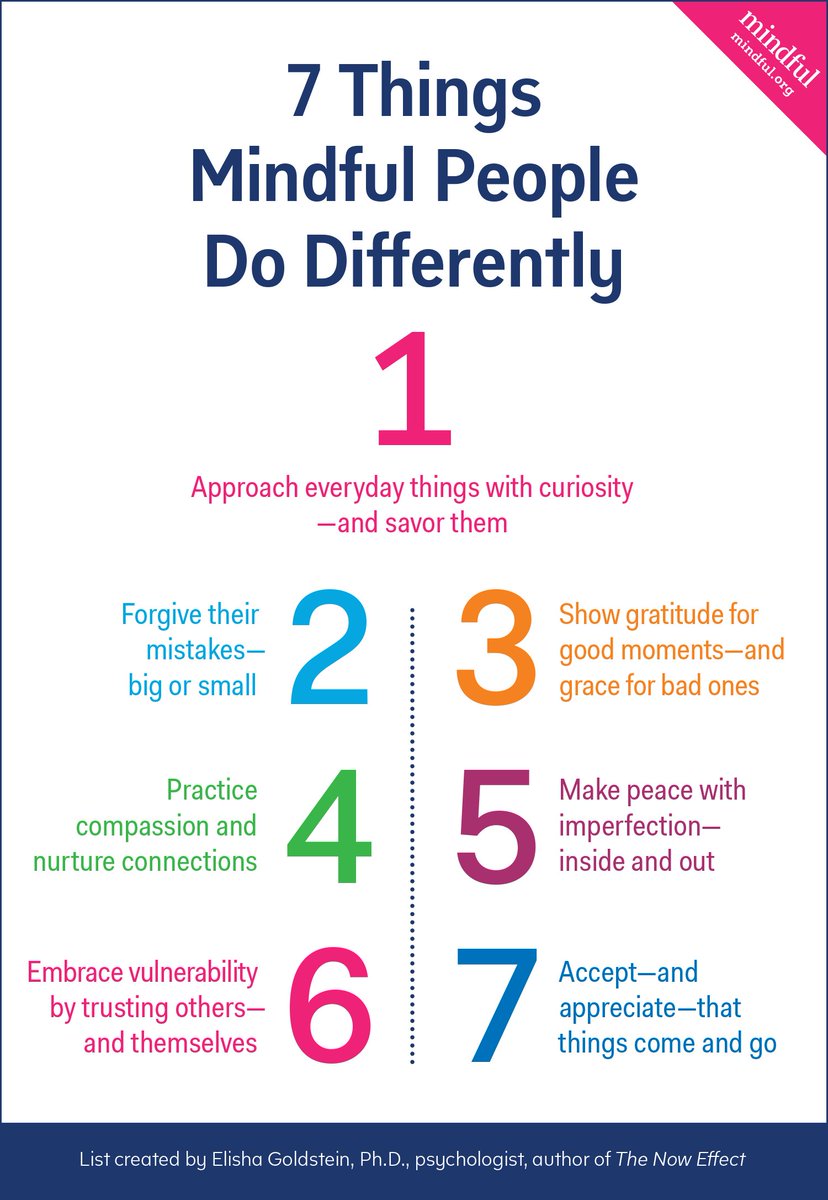
7 Principles for Mindful Living


 7 Principles for Mindful Living:

Wednesday, December 7, 2016

"Consciousness is everywhere"


Neuroscience Is Learning What Buddhism Has Known For Ages: "Consciousness is everywhere": 


Tuesday, November 22, 2016

Living with a sense of purpose in life


Conclusion:

A sense of purpose in life also gives you this considerable advantage:
"People with a sense of purpose in life have a lower risk of death and cardiovascular disease."

The conclusions come from over 136,000 people who took part in 10 different studies.

Participants in the studies were mostly from the US and Japan.


The US studies asked people:
  • how useful they felt to others,
  • about their sense of purpose, and
  • the meaning they got out of life.


The Japanese studies asked people about ‘ikigai’ or whether their life was worth living.

The participants, whose average age was 67, were tracked for around 7 years.

During that time almost 20,000 died.
 
But, amongst those with a strong sense of purpose or high ‘ikigai’, the risk of death was one-fifth lower.

Despite the link between sense of purpose and health being so intuitive, scientists are not sure of the mechanism.

Sense of purpose is likely to improve health by strengthening the body against stress.

It is also likely to be linked to healthier behaviours.

Dr. Alan Rozanski, one of the study’s authors, said:
“Of note, having a strong sense of life purpose has long been postulated to be an important dimension of life, providing people with a sense of vitality motivation and resilience.
Nevertheless, the medical implications of living with a high or low sense of life purpose have only recently caught the attention of investigators.
The current findings are important because they may open up new potential interventions for helping people to promote their health and sense of well-being.”

This research on links between sense of purpose in life and longevity is getting stronger all the time:
  • “A 2009 study of 1,238 elderly people found that those with a sense of purpose lived longer.
  • A 2010 study of 900 older adults found that those with a greater sense of purpose were much less likely to develop Alzheimer’s disease.
  • Survey data often links a sense of purpose in life with increased happiness.
No matter what your age, then, it’s worth thinking about what gives your life meaning.”


Read More:

Find out what kinds of things people say give their lives meaning.
Here’s an exercise for increasing meaningfulness
And a study finding that feeling you belong increases the sense of meaning.

The study was published in the journal Psychosomatic Medicine (Cohen et al., 2015).


A sense of purpose in life
Link: http://www.spring.org.uk/2015/12/here-is-why-a-sense-of-purpose-in-life-is-important-for-health

Sunday, November 20, 2016

​Are You Too Busy To Live in the Moment?

​Are You Too Busy To Live in the Moment?

​Are You Too Busy To Live in the Moment?

Contributed By
shares
This is one of the best one-liners I get from people who are learning how to live in the moment – “I’m too busy!”
Living in the moment is a crucial part of bringing mindfulness into your daily life. My formula for living in the moment is to repeatedly bring my mind back to the present time and my present situation, 100 times a day. That means every 5 minutes for an 8-hour timeframe. Eventually you’ll become present, and your thoughts will no longer drift to the past or to the future. And then the reminders are no longer necessary, because you are in the now for good. I have been living in the now since 2006, but it took me 6 months of active training to learn how to harness my mind to be in the present moment.
According to Harvard research, most people are absentminded for 47% of their lives. That’s no life!
If you follow my example and focus your energy on living in the moment, you should increase your in-the-moment percentage to 100% within 4-6 weeks, and then you can work to sustain it from there.
The difference is like night and day when you compare an absentminded person’s life, when the mind is wandering for half of your day, to the productivity that naturally unfolds when your presence is honed. Ask yourself:
What is more important than this moment anyway?
What is more important than your happiness?
What is more important than your productivity?
Instead of thinking you are too busy to live in the now, accept that your productivity will actually improve with a mindful focus on the present. Commit to drawing your mind back to the moment at hand, and soon it will be a habit that boosts your productivity and reduces time spent worrying or stressing about how busy you are.
Comments ▼

Wednesday, November 16, 2016

How can mindfulness change your life"Jon Kabat Zin.


How can mindfulness change your life Jon Kabat Zin talks about how it works. https://sites.google.com/site/healthi...
The history of clinical stress Jon Kabat Zinn (click subtitles for the
French version) The Centre for Mindfulness in Medicine, Health Care,
and Society is a visionary force and global leader in mind-body
medicine. For thirty years, we have pioneered the integration of
mindfulness meditation and other approaches based on mindfulness in
traditional medicine and health through patient care, academic medical
research and vocational training, and in society in general through
various outreach initiatives and public service. Directed by Saki F.
Santorelli, EDD, MA, since 2000 and founded in 1995 by Jon Kabat-Zinn,
Ph.D., of the Centre is an outgrowth of the famous Stress Reduction
Clinic - the oldest and the largest university medical centre based on
the reduction of stress in the world. Association for the Development of
Mindfulness http://www.association-mindfulness.org
https://sites.google.com/site/healthi...
https://www.youtube.com/watch?v=D2iYp...
https://www.youtube.com/watch?v=ZikN0...


Tuesday, November 15, 2016

Feeling good | David Burns | TEDxReno


Published on Sep 5, 2014
This
talk was given at a local TEDx event, produced independently of the TED
Conferences. Why do we sometimes fall into black holes of depression,
anxiety and self-doubt? And can we change the way we feel?

Dr.
Burns graduated magna cum laude from Amherst College, received his M.D.
from Stanford University School of Medicine and completed his psychiatry
residency at the University of Pennsylvania School of Medicine. He has
served as Acting Chief of Psychiatry at the Presbyterian / University of
Pennsylvania Medical Center (1988) and Visiting Scholar at the Harvard
Medical School (1998), and is certified by the National Board of
Psychiatry and Neurology.

Dr. Burns is currently Adjunct Clinical
Professor Emeritus of Psychiatry and Behavioral Sciences at the
Stanford University School of Medicine, where he is involved in research
and teaching. He has received numerous awards, including the A. E.
Bennett Award for his research on brain chemistry, the Distinguished
Contribution to Psychology through the Media Award, and the Outstanding
Contributions Award from the National Association of
Cognitive-Behavioral Therapists. He has been named Teacher of the Year
three times from the class of graduating residents at Stanford
University School of Medicine, and feels especially proud of this award.

In
addition to his academic research, Dr. Burns has written a number of
popular books on mood and relationship problems. His best-selling
book,Feeling Good: The New Mood Therapy, has sold over 4 million copies
in the United States, and many more worldwide. Feeling Good is the book
most frequently “prescribed” for depressed patients by psychiatrists and
psychologists in the United States and Canada. Surveys indicate that
American mental health professionals rate Feeling Good as the #1 book on
depression, out of a list of 1,000 self-help books.

In 1995, Dr.
Burns and his family returned to California from Philadelphia. When he
is not crunching statistics for his research, he can be found teaching
his famous Tuesday evening psychotherapy training group for Stanford
students and community clinicians, or giving workshops for mental health
professionals throughout the United States and Canada.

To learn
more about Dr. Burns, you can check out his Wikipedia page or read a
recent article about Dr. Burns by Robert Strauss in the Stanford
Magazine.

About TEDx, x = independently organized event In the
spirit of ideas worth spreading, TEDx is a program of local,
self-organized events that bring people together to share a TED-like
experience. At a TEDx event, TEDTalks video and live speakers combine to
spark deep discussion and connection in a small group. These local,
self-organized events are branded TEDx, where x = independently
organized TED event. The TED Conference provides general guidance for
the TEDx program, but individual TEDx events are self-organized.*
(*Subject to certain rules and regulations)


The mindful way through depression: Zindel Segal at TEDxUTSC